
Catastrophe auto claim scenarios are defined as insurance claim events triggered by large-scale disasters that cause vehicle damage across a wide geographic area, typically classified when insured losses exceed $25 million in damages. These events activate specialized claims protocols that differ fundamentally from standard auto claim processing. Adjusters and fleet managers who understand the distinct types of catastrophe auto claim scenarios gain a critical operational advantage. Claim volumes can surge 10–12 times baseline within 48 hours of a major event, making preparation and scenario knowledge non-negotiable for any carrier or fleet operation.
1. What are the primary types of catastrophe auto claim scenarios?
Catastrophe claims adjusting, the industry term for managing high-volume auto claims triggered by large-scale disasters, covers six primary event categories. Each category produces a distinct damage profile, claim complexity level, and operational demand.
- Hurricanes and tropical storms. Wind, storm surge, and flooding combine to produce mixed damage types including total losses, flood damage, and debris impact. Claims often involve both collision and comprehensive coverage, complicating triage.
- Hailstorms. The highest-volume catastrophe claim driver in the U.S. Hail produces body panel dents, glass breakage, and roof damage across thousands of vehicles in a single storm path. Most claims fall under comprehensive coverage.
- Floods. Flooding produces the highest total-loss rates of any weather event because electrical system damage makes repairs economically unfeasible. Comprehensive coverage pays for flood damage; collision coverage does not.
- Wildfires. Vehicles in wildfire zones suffer total destruction or severe heat and smoke damage. Electrical system compromise is common, driving high total-loss determinations.
- Tornadoes. Concentrated but highly destructive. Tornado claims involve flying debris, rollovers, and structural crush damage. Geographic concentration means adjusters face intense localized surges.
- Human-made catastrophes. Civil unrest, riots, malicious damage, and infrastructure failures produce vehicle damage covered under comprehensive policies. These events require different underwriting and fraud screening protocols than natural disasters.
Understanding which category an event falls into determines coverage applicability, adjuster deployment strategy, and settlement timelines.
2. How do hailstorms and wildfires shape catastrophe auto claim handling?

Hailstorms are the single largest volume driver in catastrophe auto claims. A single storm system crossing a metropolitan area can generate tens of thousands of comprehensive claims within hours. Damage ranges from minor dents requiring paintless dent repair to shattered glass and total losses on vehicles with pre-existing damage.
Wildfires produce the opposite profile: lower claim volume but dramatically higher total-loss rates. Electrical system damage from extreme heat renders most affected vehicles beyond economical repair. State total-loss thresholds, which typically fall in the 70–80% range of actual cash value, are routinely exceeded in wildfire scenarios.
| Event Type | Typical Claim Complexity | Common Damage | Primary Operational Challenge |
|---|---|---|---|
| Hailstorm | Low to moderate | Dents, glass, roof panels | High volume intake, rapid triage |
| Wildfire | High | Total loss, electrical damage | Salvage coordination, settlement accuracy |
| Flood | High | Electrical, interior, total loss | Total-loss determination, salvage title |
| Hurricane | Mixed | Wind, flood, debris | Multi-coverage coordination |
| Tornado | Moderate to high | Structural, debris impact | Localized surge, field access |
Pro Tip: In hailstorm events, deploy paintless dent repair vendors immediately. Delays push minor claims into supplement cycles that inflate costs and extend cycle times.
Wildfire total-loss claims require accurate actual cash value determinations from the start. Errors in initial estimates create supplement disputes that slow settlements and damage policyholder relationships.
3. How do human-made catastrophe scenarios differ from natural disasters?
Human-made catastrophes produce auto damage through mechanisms that standard weather protocols do not anticipate. Civil unrest events, including riots and protests that escalate to property destruction, generate claims for broken glass, fire damage, and vandalism under comprehensive coverage. Terrorism events and infrastructure failures such as extended power outages create additional complexity.
The key differences from natural disaster claims include:
- Coverage ambiguity. Some human-made events trigger policy exclusions that weather events do not. Adjusters must verify whether the specific cause of damage falls within comprehensive coverage or triggers a policy exclusion.
- Fraud exposure. Malicious damage claims carry higher fraud risk than weather claims. Pre-loss condition documentation and scene evidence become critical in claim validation.
- Geographic unpredictability. Natural disasters follow weather patterns. Civil unrest can emerge in any urban area with little warning, making pre-positioned adjuster deployment impossible.
- Vendor coordination challenges. Body shops and glass vendors in affected areas may be closed or inaccessible during active civil unrest, extending repair timelines significantly.
Pro Tip: For civil unrest claims, require photo documentation of the surrounding area at the time of damage, not just the vehicle. Context evidence reduces fraud exposure and supports faster coverage decisions.
AI tools assist catastrophe claims by triaging incoming claims and flagging anomalies that indicate potential fraud, which is especially valuable in human-made catastrophe scenarios where damage patterns are less predictable.
4. What are best practices for catastrophe claim surge management?
Catastrophe claim surge management is the operational discipline of absorbing and processing abnormal claim volumes without service failure. The two primary staffing models are dedicated standby teams and event-driven variable staffing.
Variable staffing models reduce surge costs by 40% while maintaining 90% service compliance. These models activate surge teams within 24 hours of an event, eliminating the overhead of maintaining permanent standby capacity. That cost reduction directly improves loss adjustment expense ratios for carriers managing multiple CAT events per year.
Effective surge management combines staffing flexibility with technology:
- AI-assisted triage. AI command centers absorb 8–12x normal claims intake without increasing headcount by automatically sorting claims by complexity and urgency.
- Automated vendor onboarding. Self-service vendor portals reduce surge activation time from 5–10 days to under 48 hours, accelerating repair mobilization.
- Two-tier claim triage. Settle high-volume, low-complexity claims quickly. Free experienced adjusters to focus on total loss and complex cases that require technical judgment.
- Cross-trained staff deployment. AI provides real-time SOP guidance to cross-trained staff, expanding workforce capacity without requiring full adjuster certification for every role.
The critical insight from 2026 operations is that AI's primary value in catastrophe claims is not replacing adjusters. It is expanding adjuster capacity by handling intake, routing, and SOP guidance so experienced professionals focus on decisions that require judgment.
5. What claim handling scenarios should adjusters and fleet managers anticipate?
Auto claim disaster examples vary significantly by event type, and adjusters who prepare for specific scenarios perform better under field conditions. The following scenarios represent the most common operational realities in catastrophe deployments.
High-volume hail events. An adjuster working a metropolitan hailstorm may process 15–25 claims per day, most involving minor to moderate body damage. Speed and accuracy in damage documentation determine both policyholder satisfaction and adjuster productivity under production-based pay structures.
Flood and wildfire total-loss claims. These claims require precise actual cash value calculations, salvage coordination, and title processing. Errors at the estimate stage create supplement disputes that extend settlement timelines by weeks. Fleet managers with large vehicle inventories in affected areas face compounded complexity when multiple units require simultaneous total-loss processing.
"Independent catastrophe adjusters often work 10–14 hour days in challenging field conditions, covering their own lodging and operational expenses. Adjusters who build preferred roster status through consistent performance and compliance can earn 2–3 times their normal income during major CAT deployments."
Policyholder communication in disaster zones presents a separate operational challenge. Affected policyholders are often displaced, stressed, and without reliable phone or internet access. Adjusters who establish clear communication protocols early in the claim reduce escalations and complaints.
Independent adjusters face substantial unreimbursed costs during CAT deployments that reduce net income well below gross billings. Fleet managers negotiating with carriers on fleet claim settlements should account for these operational realities when evaluating adjuster responsiveness and turnaround expectations.
Key takeaways
Catastrophe auto claim scenarios require adjusters and fleet managers to match their response strategy to the specific event type, because each category produces a distinct damage profile, coverage trigger, and operational demand.
| Point | Details |
|---|---|
| Event type determines coverage | Flood, wildfire, and hail claims fall under comprehensive coverage; collision coverage does not apply. |
| Surge volumes require automation | AI command centers absorb 8–12x normal intake without adding headcount during CAT events. |
| Variable staffing cuts costs | Event-driven staffing models reduce surge costs by 40% while maintaining 90% service compliance. |
| Two-tier triage improves outcomes | Settling minor claims fast frees experienced adjusters to handle total losses and complex cases. |
| Human-made events need different protocols | Civil unrest and malicious damage claims carry higher fraud risk and require scene documentation. |
What I've learned from watching catastrophe claims operations evolve
The conversation about AI in catastrophe claims often focuses on automation as a cost-cutting tool. That framing misses the real operational shift happening in 2026. The immediate value of AI in CAT operations is not replacing adjusters. It is giving cross-trained staff real-time SOP guidance so carriers can scale their workforce within hours instead of days.
What I find underappreciated is how much the quality of the initial estimate determines everything downstream. In wildfire and flood total-loss scenarios, an inaccurate actual cash value figure at the first estimate creates a supplement dispute that can add weeks to settlement. Carriers and fleet managers who invest in accurate front-end estimating avoid the back-end costs that quietly inflate loss adjustment expenses.
The adjuster experience side of this is also worth stating plainly. CAT deployments are physically and financially demanding. Adjusters working 10–14 hour days in the field, covering their own expenses, and operating under production-based pay structures need carriers and fleet managers who understand that dynamic. Preferred roster status goes to adjusters who deliver consistent, compliant work. Carriers who treat adjuster relationships as transactional during surge events pay for it in quality and availability during the next event.
The future of catastrophe auto claim handling belongs to operations that combine flexible staffing, accurate estimating, and technology-assisted triage. None of those three elements works well without the other two.
— Izaz
Audenyx and catastrophe auto claim accuracy
Catastrophe events expose every gap in an estimating and audit process. When claim volumes spike and cycle time pressure is highest, estimate accuracy is what separates carriers that control loss adjustment expenses from those that absorb unnecessary supplement costs.
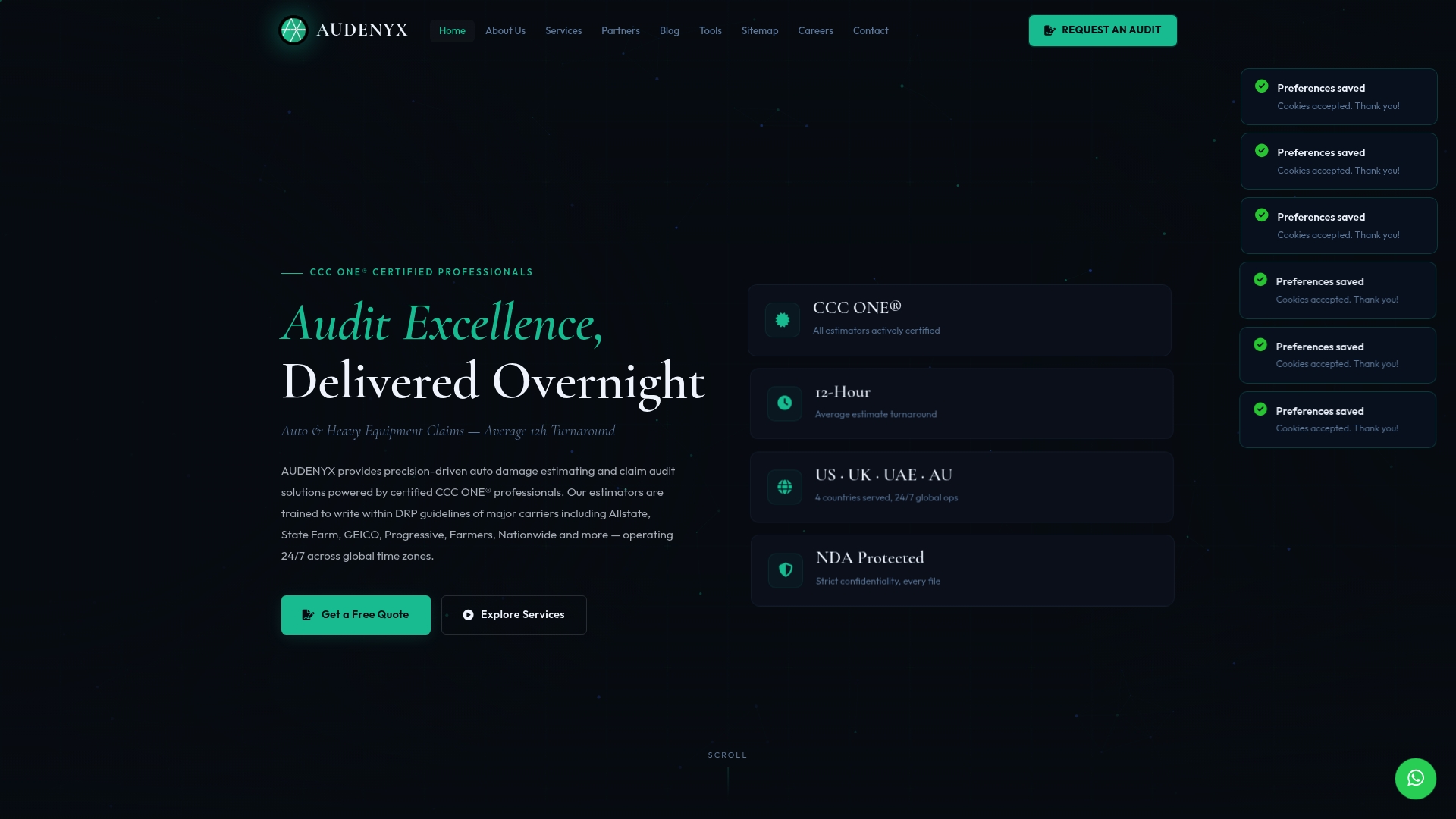
Audenyx provides expert auto claims auditing with a 12-hour turnaround, staffed by certified CCC ONE® professionals trained within DRP guidelines for major carriers including Allstate, State Farm, GEICO, Progressive, Farmers, and Nationwide. Audenyx operates 24/7 across global time zones, which means CAT surge events do not create audit backlogs. Carriers and fleet managers who need accurate, compliant estimates during high-volume events can rely on Audenyx to maintain quality when internal capacity is stretched.
FAQ
What is catastrophe claims adjusting?
Catastrophe claims adjusting is the specialized practice of processing high-volume auto and property insurance claims triggered by large-scale disasters. It requires distinct staffing models, triage protocols, and vendor coordination compared to standard claims handling.
What types of auto damage claims are most common in CAT events?
Hailstorms generate the highest volume of comprehensive auto claims, while floods and wildfires produce the highest total-loss rates due to electrical system damage that makes repairs economically unfeasible.
How do carriers manage catastrophe claim surges without adding permanent staff?
Event-driven variable staffing models activate surge teams within 24 hours and reduce surge staffing costs by 40% while maintaining 90% service compliance, eliminating the overhead of permanent standby capacity.
What coverage applies to catastrophe auto damage?
Comprehensive coverage pays for non-collision catastrophic damage including hail, floods, hurricanes, wildfires, and civil unrest. Collision coverage does not apply to weather or human-made catastrophe damage.
How do adjusters build preferred roster status in CAT deployments?
Adjusters who deliver consistent, compliant claim documentation and meet production expectations under field conditions earn preferred roster placement, which gives them priority access to future CAT deployments where earnings can reach 2–3 times normal income.